Sponsered

Tuesday, July 30, 2013

First Europeans

Oldest Poison Pushes Back Ancient Civilization 20,000 Years Live Science - July 30, 2012

The late Stone Age may have had an earlier start in Africa than previously thought - by some 20,000 years. new analysis of artifacts from a cave in South Africa reveals that the residents were carving bone tools, using pigments, making beads and even using poison 44,000 years ago. These sorts of artifacts had previously been linked to the San culture, which was thought to have emerged around 20,000 years ago. "Our research proves that the Later Stone Age emerged in South Africa far earlier than has been believed and occurred at about the same time as the arrival of modern humans in Europe," study researcher Paola Villa, a curator at the University of Colorado Museum of Natural History, said in a statement.
Later Stone Age Got Earlier Start in South Africa Than Thought Science Daily - July 30, 2012
The Later Stone Age emerged in South Africa more than 20,000 years earlier than previously believed - about the same time humans were migrating from Africa to the European continent, says a new international study led by the University of Colorado Boulder. The study shows the onset of the Later Stone Age in South Africa likely began some 44,000 to 42,000 years ago, said Paola Villa, a curator at the University of Colorado Museum of Natural History and lead study author. The new dates are based on the use of precisely calibrated radiocarbon dates linked to organic artifacts found at Border Cave in the Lebombo Mountains on the border of South Africa and Swaziland containing evidence of hominid occupation going back 200,000 years.
Teeth and jaw are from 'earliest Europeans' BBC - November 2, 2011
Worn ancient teeth and a jaw fragment unearthed in the UK and Italy have something revealing to say about how modern humans conquered the globe. The finds in Kents Cavern, Devon, and Grotta del Cavallo, Apulia, have been confirmed as the earliest known remains of Homo sapiens in Europe. Careful dating suggests they are more than 41,000 years old, and perhaps as much as 45,000 years old in the case of the Italian "baby teeth".
Early human fossils unearthed in Ukraine BBC - June 21, 2011
Ancient remains uncovered in Ukraine represent some of the oldest evidence of modern people in Europe, experts have claimed. Archaeologists found human bones and teeth, tools, ivory ornaments and animal remains at the Buran-Kaya cave site. The 32,000-year-old fossils bear cut marks suggesting they were defleshed as part of a post-mortem ritual.
Archaeologists discover Britain's 'oldest house' BBC - August 11, 2010
Archaeologists are claiming to have discovered the oldest house in Britain. The circular structure, found at a site near Scarborough, North Yorkshire, has been dated as being made in 8,500 BC. Described as a "sensational discovery" by archaeologists, this is 500 years earlier than the previous oldest house.
Humans' early arrival in Britain BBC - July 8, 2010
Stone Age Europeans Get Older and Colder Wired - July 8, 2010
Europe's Ancestors: Cro-Magnon 28,000 Years Old Had DNA Like Modern Humans Science Daily - July 16, 2008
"First European" Confirmed to Be 1.2 Million Years Old National Geographic - March 27, 2008
First Europeans Came From Asia, Not Africa, Tooth Study Suggests National Geographic - August 6, 2007
Fossil Tooth Belonged to Earliest Western European, Experts Say National Geographic - July 2, 2007
Skull Is First Fossil Proof of Human Migration Theory, Study Says National Geographic - January 13, 2007
Clues found for early Europeans BBC - January 13, 2007
Stone Tools Reveal Humans Lived in Britain 700,000 Years Ago National Geographic - December 17, 2005
Early Humans Settled India Before Europe, Study Suggests National Geographic - November 14, 2005
Prehistoric Bones Point to First Modern-Human Settlement in Europe National Geographic - May 19, 2005
DNA Study Traces European Ancestors to 10 Men
November 10, 2000 - AP
About 80 percent of Europeans arose from primitive hunters who arrived about 40,000 years ago, endured the long ice age and then expanded rapidly to dominate the continent, a new study shows. Researchers analyzing the Y chromosome taken from 1,007 men from 25 different locations in Europe found a pattern that suggests four out of five of the men shared a common male ancestor about 40,000 years ago.
Peter A. Underhill, a senior researcher at the Stanford Genome Technology Center in Palo Alto, Calif., and co-author of the study, said the research supports conclusions from archaeological, linguistic and other DNA evidence about the settlement of Europe by ancient peoples. When we can get different lines of evidence that tell the same story, then we feel we are telling the true history of the species. The researchers used the Y chromosome in the study because its rare changes establish a pattern that can be traced back hundreds of generations, thus helping to plot the movement of ancient humans. The Y chromosome is inherited only by sons from their fathers. When sperm carrying the Y chromosome fertilizes an egg it directs the resulting baby to be a male. An X chromosome from the father allows a fertilized egg to be female.
"The Y chromosome has about 60 million DNA base pairs. Changes in those base pairs happen infrequently, but they occur often enough to establish patterns that can be used to trace the ancestry of people. Researchers looking at the 1,007 chromosome samples from Europe identified 22 specific markers that formed a specific pattern of change. Underhill said the researchers found that about 80 percent of all European males shared a single pattern, suggesting they had a common ancestor thousands of generations ago.
"The basic pattern had some changes that apparently developed among people who once shared a common ancestor and then were isolated for many generations. This scenario supports other studies about the Paleolithic European groups. Those studies suggest that a primitive, stone-age human came to Europe, probably from Central Asia and the Middle East, in two waves of migration beginning about 40,000 years ago. Their numbers were small and they lived byhunting animals and gathering plant food. They used crudely sharpened stones and fire.
"About 24,000 years ago, the last ice age began, with mountain-sized glaciers moving across most of Europe. The Paleolithic Europeans retreated before the ice, finding refuge for hundreds of generations in three areas: what is now Spain, the Balkans and the Ukraine.
"When the glaciers melted, about 16,000 years ago, the Paleolithic tribes resettled the rest of Europe. Y chromosome mutations occurred among people in each of the ice age refuges, said Underhill. He said the research shows a pattern that developed in Spain is now most common in northwest Europe, while the Ukraine pattern is mostly in Eastern Europe and the Balkan pattern is most common in Central Europe.
"About 8,000 years ago a more advanced people, the Neolithic, migrated to Europe from the Middle East, bringing with them a new Y chromosome pattern and a new way of life - agriculture. About 20 percent of Europeans now have the Y chromosome pattern from this migration.
"Archaeological digs in European caves clearly show that before 8,000 years ago, most humans lived by gathering and hunting. After that, there are traces of grains and other agricultural products. Earlier studies had traced European migration patterns using the DNA contained in the mitochondria, a key part of each cell. This type is DNA is passed down from mother to daughter."
Antonio Torroni, a researcher at the University of Urbino, Italy, who first proposed that early humans retreated to Spain during the ice age, said in a separate Science report that the Y chromosome study fits completely' with the mitochondria studies.
"The Y chromosome studies are also consistent with genetic studies showing a broader picture of human migration. In general, studies show that modern humans first arose in Africa about 100,000 years ago and thousands of years later began a long series of migrations, he said. Some groups migrated eastward and humans are known to have existed in Australia about 60,000 years ago. Other groups crossed the land bridge into the Middle East. Humans appeared in Central Asia about 50,000 years ago. From there, the theory goes, some migrated west, arriving in Europe about 40,000 years ago. Later, some migrated east, across the Bering Straits, to the Americas."

Saturday, July 20, 2013

“Хор чойнжун буюу Хорын нутагт Бурханы шашин дэлгэрсэн”


“Хор чойнжун буюу Хорын нутагт Бурханы шашин дэлгэрсэн” нь хэмээх Төвд-Монголын уран зохиолын нэгэн сонирхолтой төрөл бий. Энэ төрлийн олон зохиолууд байдаг. XIII-XX зууны үеийн Төвдийн эрдэмтэд Төв Азийн улсуудыг ерөнхийд нь “Хор” хэмээн нэрийдэж байсан бөгөөд энэ нь одоогийн Монгол угсаатнуудыг нэрлэж байжээ. Чингэхлээх энэ "ХОР" гэсэн үг нь ямар утга агуулж байгаа бол? тайлбарлаж өгөөч? ...Хэмээх мэргэжлийн төвд судлал талаас нь зохих хүмүүсээс асуух Хор Монголын эргэн тойронд.  
.Like · · Unfollow Post · 5 hours ago


Nyamochir Gonchog Хор гэдэг нь хоромсог саадагны нэр гэдэг.
4 hours ago · Unlike · 1

Batchuka Bodonguud Утгийг цааш нь хөөвөл Монгол үг биш болох магадлал бий юу?
4 hours ago · Like

Batchuka Bodonguud "Хор" гэх язгуураар цөөнгүй утга салаалдаг... Тус утгаар эргэцүүлвэл их сонин байна. Сонирхолтой санагдаад байна.
4 hours ago · Like

Nyamochir Gonchog Gavalaa ajilluul. Korea gedeg yg jishee ni so helend utga zaadaggui. Ertnii yg. Num sum agsagch gsen yg sh dee. Bid harvah namnahdaa iluu l bsan bhgui yu. oilgoj yadah yuj bna
56 minutes ago · Unlike · 1

Batchuka Bodonguud за за
39 minutes ago · Like

Gantuya Olhunoud Utsaarlahqui yarij baiya l daa. Bi ch bas medehqui sh dee.
22 minutes ago · Edited · Like

Batchuka Bodonguud Ойлгомжтой л доо жаахан утга хөөж үзэх гээд... Уурлуулсан бол уучлаарай. Би гавал биш тархиа ажиллуулаад бодоход хэхэ... нэг ийм таамаглал байна. Хор Монгол,
“Хүнхээр”
Хоромсог саадаг,
Хар хорин, Хороо, Хүрээ, 
Хорь Буриад
ХАРИЦУУЛСАН ХЭЛ ШИНЖЛЭЛ: Орчуулга
-ki-ir-¯é (< *Ker-) ‘хотын дээд ханан хэрэм’ (Catsanicos 1996) *Ker-/*Kor-/*kr-, *KerH- /*KorH-/*KrH- ‘бүхэл юмсын хамгийн дээд (ямар нэгэн юмны): Эвэр, толгой эсвэл тэргүүн, гавал, тэргүүний титэм; үзүүр, оргил, дээд хэмжээ, уулын оргил; эвэрлэсэн бодгаль’ (Pokorny 1959:574—577; Walde 1927—1932.I:403— 408; Mann 1984—1987:609— 610, 611, 612, 613, 614, 638, 638—639, 639, 640; Puhvel 1984— .4:77—79; Kloekhorst 2008:446—447) 

Самгард śíras- (< *KrHes-) ‘ тэргүүн, гавал’, ś1yga-m ‘ямар нэгэн амьтны эвэр; зааны соёо; оргил буюу уулын оройн цэг, оргил; бүтээн байгуулалтын хамгийн өндөр хэсэг, шовгор орой, харш; ямар нэгэн оргил, өөрөөр хэлбэл тусах цэг, дээд зэргэлэлт байдал, өндөрлөг, үзүүр хэсэг, төгсгөл, туйлын’, śīr[á-‘ тэргүүн толгой, гавал; дээд талын хэсэг, үзүүр, оргил (ямар нэгэн юмны)’, śīr[án- (< *KrHsen-) ‘толгой тэргүүн’; ...............................................................................Гэх үгс тус бүр утга салаалаад эхэлсэн юм. Гэтэл Монгол хэлний үгсийн санд буй үгийг түүж үзвэл сонирхолтой байна. Миний судалгаанд эртний Энэтхэг тэр дундаа Төвдүүд нарын үгийн Хор гэсэн нь Монгол хүмүүсийг /Монгол газар/ нэрлэсэн нэрлэгээтэйнэгийг бодогдуулам. Эртний Энэтхэгийн умард биеэр оршигч Төвдүүд түүхэндээ дундад эртний Монголчуудыг хор Монголчууд хэмээн нэрлэж байсан нь нилээд сонирхолтой нэрлэгээ, зүйрлэл байж болох юм. Хор Монгол хэмээх нэрийн утга гарвал талаас нь эрдэмтэд янз бүрийн санал гаргаж хэлэлцдэг бөгөөд эдүгээ тийм ч нарийн шийдвэрт хүрсэн зүйлгүй байгаа учир нь танаас авч буй хоромсог гэх гэх нийтлэг боловч төдийлөн цэг тавих зүйлгүй. Тэгээд ч наана гавалаа ажиллуул энэ тэр гэх зүйлгүй. .............................Жишээлбэл: С. Дулам гуайн бүтээлд дурдсанаар бол “...Бид өөрсдийн нэрийг “нарны хүмүүс”, “нарны үр сад” гэсэн маягаар аль алиных нь утгыг ч давхар хадгалан нэрлэсэн байж болох юм. Монгол ардын оньсгонд монгол нэрийг “Хүнхээрийн хаан хүнээр бөөлжинө” гэж оньсгологолдогийн “Хүнхээр” гэдэг үгийн утгыг бид “Хүнхорын хаан” гэж тайлж болох бөгөөд энэ нэрийн эхний хэсэг нь хүн/нү/ гэдэг нэрийн “хүн”, сүүлийн “хор” гэдэг нь төв азийн Төвд, Тангад зэрэг угсаатнаас Монголчуудыг нэрлэдэг нэр буюу “Хор Монгол” гэдэг үгийн “хор” (HOR) болно. Өөрөөр хэлбэл, нийт эсгий туургатныг нэрлэсэн нэрийдэл нь “хүнхээр” буюу “хүнхор” болой. Энэхүү “Хор Монгол” гэдэг үгийн “хор” нь зарим монгол угсаатан тухайлбал Хорь Буриадын нэрийн нэгэн хэсэг болоод уламжлан явж байдаг.” Гэжээ. Үүнд мэдээж эргэлзэх зүйл байгаа. Гэхдээ нээлт бус таамаглал. Индо Иран нутгийн овог аймаг тэдний нэгэн хотыг Хор----езм гэх агаад Хор гэх утгаар нь үзвэл "Тэнгэрт буй наран---эсхүл гал бутарсан гэрэлт илч" хэмээн тайлдагч биднийг хэлсэн Хор Монгол, Хордохын хор-хорлол---эсвэл Индо Европын язгуур HORN--HOR etc ---Эвэр, эвэрлэг, эвэртэн... үзвэл бас л сонин. ...............Зарим судалгааны эх бүтээл дээр “Хор” гэх үгийн утгыг тайлахдаа “хор саадаг”, “хоромсого”, “зэр зэвсэг” гэсэн утгаар авч хэлэлцсэн нь миний хувьд үгүйсгэмээр санагддаг. 
““Хорий-а-гоор дэгүрин хонитой
Хойар мүнгтэн йорху-а-тай”
гэсэн Буриадуудын дунд хэлэлцэж байсан нэг оньсого байх бөгөөд тааврын хариу нь “одон мүчин, наран, саран” юм” . Гэсэн оньсого “хоорий” гэх үг нь их том дайд зүйл бөгөөд түүн дотор од, нар, сар багтаан хамруулсан нь үлэмж хэмжээний зүйл мэт санагдмаар. Эсхүл Хороо хорин /Орд харш/ ***Алтан Орд-Hord***гэх утга шилжсэн мэтээр үзэж болохыг бас нэгэн эрхэм судлаач таамаг дэвшүүлсэн байдаг нь оновчтой байж болох юм. .......Миний энэ асуултын зорилго бол Төвд судлаач бас бичиг үсэг номын дууг нь мэддэг хүмүүс энд байж магад гэх үүднээс Мэргэжлийн тайлбар авах горьдлогтой байлаа. Хор Чойнжун гэх зохиолыг мэдээж та бүхэн мэдэх байх. Тус зохиолын Хор гэх үгийн утга миний сэтгэлийг ихэд хөдөлгөсөн билээ. 
Би мэргэжлийн төвд судлал талаас нь зохих хүмүүсээс тусламж хүсэх дүүрэн горьдлогийг энэ хүртэл өвөрлөж байлаа. 
Хойшид судалгаандаа Төвд-Самгард хэлний үгсийн санг нэхэн хөөж үзвэл зохих судалгааны шаардлага хангах боловуу гэж бодлоо. Надад туслаач. Баярлалаа үзэл бодлоо хуваалцсанд.

Batchuka Bodonguud Хирриан болон Индо Европын шинэ үгсийн дээд, тэргүүн, туйл гэх болгоныг харьцуулах нь, êïñõöÞ ‘Тэргүүн, оргил, хамгийн өндөр оноо; хаан хүний титэм; дов толгодын оройн дээд хэсэг’;
Армен хэлний sar ‘оргил, дээд хэмжээ, үзүүр’;
Латин хэлний cornū ‘a horn’, cerebrum ‘the brain’;
Гот хэлний haurn ‘horn’; Эртний Ландер horn ‘horn’, hjarsi ‘the crown of the head’, hjarni ‘brain’;
Эртний Англи хэлний horn ‘horn’;
Дэд Герман–Эртний horn ‘horn’, hirni ‘brain’;
Хиттите ka-ra-a-wa-ar ‘horn(s),antler(s)’.

Gantuya Olhunoud Khwarezm has been known also as Chorasmia, Khwarezmia, Khwarizm, Khwarazm, Khorezm, Khoresm, Khorasam, Harezm, Horezm, and Chorezm.[1]

In Avestan the name is Xvairizem, in Old Persian Huwarazmish, in Modern Persian خوارزم (Khwārazm), in Arabic خوارزم Khwārizm, in Old Chinese Hūsìmì (呼似密), modern Chinese Huālázǐmó (花剌子模), in Kazakh Хорезм, in Uzbek Xorazm, in Turkmen Horezm, in Turkish Harezm, in Greek Χορασμία and Χορασίμα, by Herodotus.

The Arab geographer Yaqut al-Hamawi in his Muʿǧam al-buldan wrote that the name was a compound (in Persian) of khwar (خوار), and razm (رزم), referring to the abundance of cooked fish as a main diet of the peoples of this area.[2]

C.E. Bosworth however, believes the Persian name to be made up of (خور) meaning "the sun" and (زم) meaning "Earth", designating "the land from which the sun rises".[3] Another view is that the Iranian compound stands for "lowland" from kh(w)ar "low" and zam "earth, land.".[1] Khwarezm is indeed the lowest region in Central Asia (except for the Caspian Sea to the far west), located on the delta of the Amu Darya on the southern shores of the Aral Sea. Various forms of khwar/khar/khor/hor are commonly used also in the Persian Gulf to stand for tidal flats, marshland, or tidal bays (e.g., Khor Musa, Khor Abdallah, Hor al-Azim, Hor al-Himar, etc.)
21 minutes ago · Unlike · 1

Batchuka Bodonguud яг тийм
21 minutes ago · Like

Batchuka Bodonguud Эндээс сонин зүйлс харагдаад байгаа юм.
20 minutes ago · Like

Gantuya Olhunoud Өөрөөр хэлбэл оросууд л Хорезм гэж бичиж байгаа болохоос уул үг нь үнэхээр "хор" язгууртай биш эртний перс хэлний хуваразм гэсэн үг юм биш үү? гэж л гайхаад байна л даа. Орчин цагийн перс хэлэнд "хуаразм" خوارزم гэж бичигддэг юм байна.
15 minutes ago · Like

Batchuka Bodonguud Yeah There are alot of facts are found from GESAR KING,....include the Gesar epic lies towards the shamanic pole in the continuum of Tibetan culture and religion, which he sees as evincing a constant tension between 'clerical' and 'shamanic' Buddhism,the latter grounded in its earlier Bön substrate. The received versions of the Ge-sar cycle are thickly overlaid with Buddhist ideas and motifs, and detecting the original 'heroic' form is difficult. Historical analysis to sift out an ancient core narrative winnows the archaic folkloric leitmotifs from features that show distinct and historically identifiable Buddhist influences. Samuel, comparing three Gesar traditions, Mongolian, Eastern Tibetan and Ladakhi, that developed relatively autonomously, postulates the following core narrative shared by all three:
(1) The Lha gling episode.
(2) The ′Khrungs gling episode.
(3) The rTa rgyugs episode.
(4) The bDud 'dul episode.
(5) The Hor gling episode.
(6) The China journey episode.
to which one might add
(7) The Srid pa'i le'u cosmogenic prelude. Source from WIKIhttps://en.wikipedia.org/wiki/Epic_of_King_Gesar

15 minutes ago · Like

Batchuka Bodonguud Таны бодол зөв дүрмийн хувьд тийм байх ёстой. Гэх дээ авай зүйн үүднээс төс Төвд, Иран-Перс язгуур нэг мэт. Та юу гэж бодож байна?
12 minutes ago · Like

Batchuka Bodonguud Бичлэгт ялгаа байна хамгийн гол нь авай зүй.
11 minutes ago · Edited · Like

Gantuya Olhunoud би мэдэхгүй ш дээ. бичлэг нь илүү тогтвортой, баримттай зүйл биш үү?
10 minutes ago · Like

Batchuka Bodonguud Хэл өөртөө авай зүй, үг зүй, өгүүлвэр зүйн нарийн хуультай байдаг. Харин Бичиг үсэг хэл сэтгэхүйн томъёо тул тухайн хэлний бүтэцээс хамаарч буудаг дүрст илэрхийлэл болох нь зөв материаллаг баримт. Миний бодолоор жинхэнэ язгуурийг дуудлаг, эх авайгаар нь анхаарч үзвэл оновчтой гэж бодно.
4 minutes ago · Like

Batchuka Bodonguud Мэдээж бүс, орон нутгийн авайн хувьсахуй буйг анхаарахгүй өнгөрч үл болнол доо. Эцэст нь аль аль талаас нь нэхэн судлах туйлийн оновчтой байх.
3 minutes ago · Like


Yesterday at 1:31am · Like

Nyamochir Gonchog pooh yanztai. Ene mayagtai bicheed bval ch chamd nogoo doovtor moovtoriig ni zygeer l ogchii. saihaan. Yneheer ajilladag gaval bna.
Yesterday at 7:40am · Like · 1

Gantuya Olhunoud яагаад цаглабарын сарыг ཧོར་ཟླ (hor sla) гэж байна?
Yesterday at 8:14am · Unlike · 1

Gantuya Olhunoud За за, мэдчихлээ. Phags-pa лам зохиогоод түүнийгээ "монгол сар" гэж нэрлэсэн юм байна.
Yesterday at 8:16am · Unlike · 1


Gantuya Olhunoud Goryeo (Koryo) 고려 нь эртний Goguryeo 고구려 династийн нэрээс үүсэлтэй юм байна. ཧོར (hor) гэдэгтэй яаж холбогдоно гэж?
Yesterday at 12:09pm · Unlike · 1

Gantuya Olhunoud хороо, хүрээ гэдэг (түрэг хэлэнд кораа гэдэг юм билээ) үгийн тухайд хэрэв төвөд үгтэй холбогдох шижим байгаа бол тэр нь утгын хувьд ཁོར (khor) སཀོར (skor) гэдэгтэй л холбогдох байх. Монгол гэдгийн ཧོར (hor) -той холбогдох зүй тогтол харагдахгүй байна.
Yesterday at 1:52pm · Unlike · 1


Gantuya Olhunoud Хорь Буриад буюу Хорь Түмэдийн хувьд энэ тухайн аймгийн холбоо буюу конфедерацид багтсан овог аймгийн тоо байх аа. Хорин овог аймгийг багтаасан том конфедерац байжээ. Хожим Ордос орчим руу шилжихдээ Хорь гэдэг үг нь гээгдэж, зөвхөн Түмэд болсон нь ч бас үүнтэй холбоотой байх. Хорин овог аймаг хориулаа нүүгээгүй байх. Гурван Мэргид, Есөн Татар, Дөчин Татар, Найман, Кыргыз гэхчилэн конфедерацид багтсан овог аймгийн тоогоор нэрлэх заншил түгээмэл байсан.
Yesterday at 2:05pm · Edited · Unlike · 1

Gantuya Olhunoud शिर head; शृङ्ग horn
Yesterday at 2:39pm · Unlike · 1

Nyamochir Gonchog 20 000 жилийн өмнө цаа буга маллаж байсан хэсэг улс хөвд дагаад тал руу бууж иржээ. Тэд дээсэн дөрөө хэрэглэж байгаад талд бууж ирэхэд Баруун Азиас төмөрлөг боловсруулах технологи ирээд ингээд анхны дөрөө хийж, морь гаршуулсан байна. Ингээд Хөвдний буюу бугын идэш тэжээл Хянганы нуруу Буйр, Хөлөн, Далай нуурын энд манай зүүн хойхно ирээд салсан тухай нэг Солонгос эрдэмтэн лекц уншиж байсан. Эндээс л анхны хоромсог саадагтан буюу төмөр сумтан бий болжээ. Тэд Эндээс хоёр тийшээ салсан Кореа, Хорь буриад, Хор монгол бололтой гэж дүгнэмээр юм билээ. Ер нь ч их боломжтой хувилбар гэж боддог.
21 hours ago · Like

Nyamochir Gonchog үг хөөцөлдөхөөс гадна ахуйн дэвшил, энэ тэртэй холбоод энэ антропрологи гэдэг ухаан чинь энэ рүүгээ ихсайн хөгжсөн байдаг юм шиг байна лээ. Жишээ нь Төв Азийн хамгийн зүүн захын хүн чулуу ч юм уу. Хайлаарын музейд байдаг юм билээ. Жижгэвтэр Хайлаар Харбины хойт зүгт Эргүнэ мөрөн, Хабул гол гээд байгаа явж үзээд бйагалийн тогтоц, музейг нь үзээд яваад байхад л гадарлана.
21 hours ago · Like

Nyamochir Gonchog Үг авиа бол яах вэ? хэдэн янзаар аяж ч хувирна. Гол нь байгалийн тогтоц эко орчны судалгаа бол бас их урагш нь чирэх бас нэг хүчин зүйл нь шүү. За тэгээд залуус минь сураад судлаад байж дээ. Төвдүүд Хор да-г Вод да буюу төвдийн сар болгосон.
21 hours ago · Like


Gantuya Olhunoud Нумын сумыг "хор" гэдэг байсан гэж уншсан л даа. Энэ нь төвөд хэлний ཧོར үнэхээр болсон уу? Энэ ཧོར гэдэгт ордог ཧ үсэг нь ямар онцлогтой үсэг үү? Тарнид энэ л ཧ үсэг орохоос нөгөө ཁ ордог билүү?
17 hours ago · Like

Д. Ганзориг tovd hor gesen ugiig zaaval mongol helnii ontsgoos harah shaardlaggui. odoo bolj baigaa tovd sudlaliin hurald Indianagiin ih surguuliin Eliot Sperling gej hyatad bolon tovdiig sudlagch hun irsen bgaa. ta buhen tuuntei uulzaj ene tuhai sanal soliltsoj bolno. Urjidar ene huntei harhorin ruu hamt yavahdaa yag ene hor sog gedeg ugnii tuhai asuusan. tuuniiheer hor gedeg bol ert uyedee uiguriig zaaj baisan bol dundad zuunaas mongoliig zaah boljee. ene ner zovhon yuan ulsin uyes chen po hor gyi yul gej mongolvjuudiig nerlesen ner boljee. uyguriig zaasan yuhor gesen ugnees garaltai gej ene erhem tailj baisan. gevch bid 2iin hoyulangiin sanal tovd hor higeed hyatad umardiin nuudelchdiig nerledeg HU gedeg ug 2iin hoorond holboo baij boloh yum gedegcdeer niilsen. SOG gefeg ugiig bol ih sonirholtoigoor tailj baidag shuu ene hun?
13 hours ago via mobile · Like13 hours ago via mobile · Like

Gantuya Olhunoud sog гэдэг үгийг юу гэж байх юм? Би бас мэдмээр байна?
10 hours ago · Like


 Нөгөөтэйгүүр зарим судалгааны бүтээлүүдэд дурдсан “хороо” гэсэн үгийн санаа нь “XY-XYI зууны үед Зүүн монголд ноёд эздийн орд өргөөгхороо” хэмээдэг байсан аж”[1]. Мөн ганцхан ноёдын орд өргөөг “хороо” гэх төдийгүй бас тэдний орд өргөөнд очиж үйлчлэн ажиллагсад, ноёд эздийн орд өргөөг дагалдан нүүдэллэж, тэдний сүргийг адгуулан маллагсдыг “хороо”, “хорооныхон” хэмээн нэрлэдэг байсан”[2].
Харин Я. Цэвэлийн “Монгол хэлний товч тайлбар толь”-д хороо /qorii-a. qorog-a/ гэсэн үгийн утгыг ийн тайлбарласан байдаг:
1.    хүрээ, хашаа; малын хороо; хашаа хороо засах;
2.    хот суурин газрын засаг захиргааны нэгж; Нийслэл хотод олон хороо бий; Найрамдлын хороонд оршин суугч; хорооны дарга
3.    дивиз буюу бригадад багтах цэргийн хэсэг анги;
4.    ямар нэгэн ажлыг эрхлэн удирдах байгууллага; төв хороо; бэлтгэх хороо; зохиолчдын хороо; хэвлэлийн хороо; утасны хороо.[3]
Чингэхлээр “Хороо” хэмээх үгийн утга миний төсөөлснөөр “Хор” язгууртай “оо” нэмсэн Алтай хэлний үг болж хувьрсан үг байх гэж төсөөлөхийн хамт “Хүрээ” хэмээх Алтай хэлний үгийн сан болж хувьссан болохыг үгүйсгэх аргагүй. “Хүрээ” хэмээх үгийн утга дараах утгаар тайлбарт гарна:
1.    юмны гадуур хашаалж хороолж хийсэн юм; хашаа хүрээ, хороо хүрээ хорш.; хүрээ хийх; шалны хүрээ;
2.    байран суурин газар; нийслэл хүрээ; хот хүрээ; хийд хүрээ; хүрээ хөдөө;
3.    юмны гадуур захаар тойрсон зүйл; зургийн хүрээ; тоононы хүрээ; сарны хүрээ;
4.    байрлан төвлөх газар байгууллага; цэргийн хүрээ; бичиг шашдар зохиох,хүрээ; эочид буух хүрээ; цэцгийн хүрээ;
5.    юмны гадуурх зах ирмэг, амсар; тогооны хүрээ; аяганы хүрээ; шархны хүрээ; мөөгний хүрээ (мөөг ургах голдуу тал дугараг хэлбэртэй тод ногоон харагдах газар; уулын бэлд байгаа мөөгний хүрээнээс цагаан мөөг түүв)[4]
“Цөөнгүй эрдэмтдийн үзсэнээр бол “хороо” хэмээх үгийн утга энэ утгаар XY-XYI зуун хамруулан авч үзсэн гэж үздэг”[5].  Харин А. Очир гуайн бүтээлд “хорийн хон” нь чухам “...энэ утгаар XIX зууны эцэс хүртэл ямар нэгэн хэмжээгээр Ар Монголд байсан”[6] гэж үздэг. Миний бодлоор бол “Хор”-“Хори”-“Хорийн”-“Хороон” хэмээх үгийн гарвал нь бүр эрт үед хамаарагдах боловуу. 

[1] Ш. Нацагдорж. “Монголын феодализмын үндсэн замнал” УБ., 1978 Тал 137
[2] Төв азийн нүүдэлчдийн угсаатаны түүхийн асуудал. УБ., 2002 Тал 48
[3]  Я.Цэвэл. Монгол Хэлний Товч Тайлбар Толь  УБ ... Тал 696
[4] Я.Цэвэл. Монгол Хэлний Товч Тайлбар Толь  УБ ... Тал 749
[5] Ш. Нацагдорж. “Монголын феодализмын үндсэн замнал” УБ., 1978 Тал 137-139
[6] Төв азийн нүүдэлчдийн угсаатаны түүхийн асуудал. УБ., 2002 Тал 48

07.20.13

Wednesday, June 26, 2013

Mysterious Celtic Mummies of the Gobi

By PHILIP COPPENS
The discovery of Caucasoid mummies in China shows that East and West have been meeting since the Bronze Age. Do they validate some of our most ancient legends? 
Christopher Columbus is said to have been the first to break down the barrier that was the Atlantic Ocean, that massive body of water separating two continents. But such a physical obstruction never existed between Europe and the East – one could always travel over land. The discovery of Caucasoid mummies in China provides not only indisputable evidence ‘Europeans’ travelled to the far East thousands of years before anyone imagined, it has also created controversy.

At the beginning of the 20th century, the likes of Sven Hedin, Albert von Le Coq and Sir Aurel Stein travelled to the East in search of ancient civilisations, hoping to reach the then forbidden city of Lhasa, the capital of Tibet, and its ruler, the Dalai Lama. On their travels to this almost mythical region, they stumbled upon many ancient ruins and on occasion spoke about the discoveries of desiccated bodies.

In 1907, the Russian explorer Pyotr Kuzmich Koslov (1863-1935) actually reached Lhasa and met the Dalai Lama. Afterwards, he organised further expeditions and excavated Khara Khoto, a Tangut city founded in 1032 that had been ruined by the Ming Chinese in 1372. Koslov unearthed a tomb fifty feet below the ruins and found the body of a woman, apparently a queen, accompanied by various sceptres, wrought in gold and other metals. Though Koslov took numerous photographs that were published inAmerican Weekly, he was not allowed to disturb or remove anything from the tomb, which was sealed again. His last expedition to Mongolia and Tibet occurred from 1923 to 1926 and resulted in the discovery of Xiongnu royal burials at Noin-Ula.

Mu & Lemuria
When news of such discoveries were reported back in the West, it ignited a wide interest in the mysteries of the East, which even today remain largely beyond the reach of most tourists. It were in these remote regions that James Churchward (1851-1936) claimed he had found evidence of a lost civilisation: Mu. For Churchward, Mu was a lost civilisation and continent in the East, which he estimated was 50,000 years old and once the home of 64 million inhabitants. Though Mu once stretched from Micronesia in the West to Easter Island and Hawaii in the Pacific Ocean, knowledge – if not descendants – of Mankind’s original homeland could possibly be found in India and surrounding regions. Churchward believed that the primary colony of Mu was the Great Uyghur Empire, Khara Khoto being its ancient capital, and the civilisation was at its height around 15,000 BCE. Check any encyclopaedia and you will find Churchward ‘borrowed’ that name from the historical Uyghur, who today live primarily in the Xinjiang Uyghur Autonomous Region of China.

Churchward’s Mu was not too different from Madame Blavatsky’s Lemuria, and it was the American Theosophist Gottfried de Purucker (1874-1942) who published his thoughts on Blavatsky’s doctrine in 1937. He argued that this region, this “enormous tract of country, most of it desert waste,” was once fertile and lush with cities, and that it was here one would “find the seat from which we came as a racial stock,” which was the “Fifth Root Race.” Blavatsky described the fifth root race as such:

The Aryan races, for instance, now varying from dark brown, almost black, red-brown-yellow, down to the whitest creamy colour, are yet all of one and the same stock – the Fifth Root-Race – and spring from one single progenitor, [...] who is said to have lived over 18,000,000 years ago, and also 850,000 years ago – at the time of the sinking of the last remnants of the great continent of Atlantis.

Later, the French author Robert Charroux (1909-1978) wrote that the Gobi Desert had Magi, or sages of the East, surpassing in wisdom even those resident in Tibet. Stories go that these cities once had ocean ports, and Edgar Cayce even argued that a “City of Gold” will be discovered in the Gobi Desert, including a temple with elevators and electric cars. Others have seen this region as the homeland of those ancient UFOs, the vimanas.
Taklamakan Desert Gives Up Its Secrets
But whereas the Gobi Desert might still hold some secrets, it is the Taklamakan Desert that has provided us with revelations. The Taklamakan Desert is a large sandy expanse, part of the Tarim Basin, a region roughly between Tibet and Mongolia, in western China, and crossed at its northern and southern edge by the Silk Road. Conditions are so harsh that travellers avoided the desert as much as possible, but in millennia gone by the region was populated and habitable – very much like de Purucker argued.
One of the Cherchen mummies
In recent decades, however, the south east section of the desert, on the edge of Gobi, has become an oasis for archaeologists and historians, as it is here that hundreds of Caucasoid mummies have been found. The most notable mummies are the tall, red-haired “Cherchen man” (dated to ca. 1000 BCE), the “Hami Mummy” (c. 1400-­800 BCE) and the “Witches of Subeshi” (4th or 3rd century BCE), who received their name because of the tall pointed hats they wore. However, the oldest mummy of all is the “Loulan Beauty” (1800 BCE).
This is Cherchen Man. He stood about six feet tall, had light hair and fair skin, and he lived about 3,000 years ago in what is today the Xinjiang region of western China. He sports facial tattoos. And the world&#8217;s oldest surviving pair of pants.
He&#8217;s among a group of mummies found in the Tarim Basin dating from between about 1900&#160;B.C. and 200&#160;A.D. I&#8217;ve wanted to write about them for a while.
I recently watched China&#8217;s Secret Mummies, a National Geographic video available on the Penn Museum&#8217;s website. It&#8217;s about 45 minutes long; unfortunately, more than half of those 45 minutes are eaten up by bullshit reenactment footage and suspense-making editing. But it&#8217;s still a good overview of the mummies, and it reveals what researchers from National Geographic&#8217;s Genographic Project were able to learn from their DNA.
What they found was surprising. After the mummies were discovered, their Caucasian facial features and woolen (sometimes plaid) textiles led many to speculate that they came from Europe, or&#8212;more fancifully&#8212;were Celts.
Sidenote: As a former Celticist (air quotes), I find this conclusion funny. I refuse to think of &#8220;Celt&#8221; as anything more than a linguistic designation, or something denoting a discrete genetic or cultural group. (Interesting and surprising read: The Origins of the British: A Genetic Detective Story by Stephen Oppenheimer.)
Anyway, like I said, the DNA results were surprising. Cherchen Man and his mummy-buddies showed east Asian genetic markers, leading the researchers to revise their understanding of the Tarim people. Likely, they were a mixed group&#8212;different cultures from east and west coexisting (and sleeping together) at a crossroads&#8212;rather than a western transplant culture hanging on in an unlikely eastern outpost, as had been previously thought. 
Hope to post about some of the other Tarim mummies in the near future.
Image Source: Uyghur American Association.
“Cherchen man”
Though not the oldest, one of the most famous mummies of the Taklamakan Desert is that of “Cherchen Man”. His body was placed in a poplar-wood box, lowered into narrow shaft grave, and left for eternity. The climatic circumstances that make this region so inhospitable today preserved these corpses over the millennia, turning them into mummies.
Yingpan mummy
Cherchen Man is six feet tall, was around fifty years old at the time of his death, has reddish brown hair, a long nose, full lips and a ginger beard. He was buried in a red twill tunic and tartan leggings, and his body is far better preserved than any Egyptian mummy. Most interestingly, Cherchen Man too was buried with no less than ten hats, one of which looks Roman, another looking like a beret, a cap, and even a conical “witch” hat – something commonly found with many of the mummies. His body dates back to 1000 BCE and he looks like a Bronze Age European. In fact, he’s every inch a Celt. Even his DNA says so.

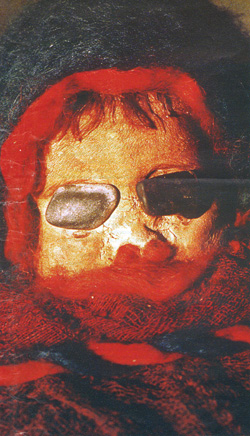
Next to him were found the mummies of three women and a baby. One of the women is dressed in a red gown, wearing tall boots, her hair brushed and braided. She has a red yarn through her ear lobes and – like the man – has several tattoos on her face. All mummies were painted with a yellow substance, believed to help in the preservation of the body. The baby, probably 3-4 months old, is wrapped in brown blankets, tied with blue and red cord, with a blue stone placed on each eye.
Loulan Beauty
The oldest of the mummies is the 4,000 year old “Loulan Beauty,”  a mummy discovered in 1980 in an ancient Chinese garrison town located by Sven Hedin in 1900. The town is near the Lop Nor marshes on the north-eastern edge of the Lop Desert. Hedin recovered many manuscripts that state the culture was wiped out by a large seismic occurrence which drastically changed the climate of the area and turned it into a desert. But that was several millennia after the Loulan Beauty lived. This female mummy has long, fair hair. Aged 45 when she died, the Loulan Beauty was buried with a basket of food containing domesticated wheat, combs and a feather. No doubt, these nourishments were for the afterlife.

She is not the lone ‘European’ to have lived here in those days: the cemetery at Yanbulaq contained no less than 29 mummies that date from 1800-500 BCE, 21 of which are Caucasoid. Best preserved of all the corpses is “Yingpan Man,” who is also known as “the Handsome Man,” a two metres tall 2,000 year old Caucasian mummy discovered in 1995. His blond bearded face was covered with a gold foil death mask, which is a Greek tradition; he also wore elaborate golden embroidered red and maroon wool garments with images of fighting Greeks or Romans. His head rests on a pillow in the shape of a crowing cockerel.

Elsewhere in the Tarim Basin, hundreds of other mummies have been found, with the earliest ones being genetically Caucausoid or Europoid. Some of the mummies are thought to have been sacrificial victims. A young woman was found partially dismembered, her eyes gouged out. A baby boy had apparently been buried alive. The question remains whether the latter was sacrificial, or he was merely buried with his dead mother.

How did Europeans End up in the Tarim Basin over 4,000 years ago?
Although their location is certainly an intriguing one, interest in these mummies exists largely because they are ‘out of place’ relics. Not only does DNA evidence show that the earliest arrivals were from Europe, analyses such as the weave of the cloth reveal it was identical to those found on the bodies of salt miners in Austria, dating from 1300 BCE. The wooden combs buried in Asia are also identical to those found in Celtic countries. So are the stone structures on top of their burial sites – similar to the dolmens of western Europe.

Despite such certainties, archaeologists and historians have struggled to fill in the ‘soft evidence’ – which are nevertheless the most important questions: how did they get to China, and why did they go?

We know about these early European visitors to the Tarim Basin largely thanks to the work of Dr. Victor Mair, a professor of Chinese Studies at the University of Pennsylvania. His fascination began when he toured the Urumchi Museum where some of the mummies are displayed. He then invited Dr. Elizabeth W. Barber of Occidental College (California) to visit the mummies and give her expert opinion on the weaving of their clothes.

“From around 1800 BCE, the earliest mummies in the Tarim Basin were exclusively Caucausoid, or Europoid,” says Mair. East Asian migrants arrived in the eastern portions of the Tarim Basin about 3,000 years ago, while the Uyghur peoples arrived after the collapse of the Orkon Uyghur Kingdom, based in modern-day Mongolia, around the year 842.

Mair has also stated:
The new finds are also forcing a reexamination of old Chinese books that describe historical or legendary figures of great height, with deep-set blue or green eyes, long noses, full beards, and red or blond hair. Scholars have traditionally scoffed at these accounts, but it now seems that they may be accurate. (http://en.wikipedia.org/wiki/Tarim_mummies)

In short, Mair leaves little doubt that we are confronted with a ‘lost civilisation’ of a group of European settlers in a region millennia before any historical accounts were recorded.

Mair believes that early Europeans headed in different directions, some travelling west to become the Celts in Britain and Ireland, others taking a northern route to become the Germanic tribes, and then another offshoot heading east and ending up in Xinjiang. His team suggests they may have arrived in the region by way of the forbidding Pamir Mountains about 5,000 years ago.

His opinions tally with those of textile expert Barber, who in her book The Mummies of Ürümchi examined the tartan-style cloth and concluded that the garments can be traced back to Anatolia and the Caucasus, the steppe area north of the Black Sea. She argues this group of people divided, starting in the Caucasus and then splitting, one group going west and another east – confirming Mair’s opinion.

So, what do we know about these people? We know they were horsemen and herders using chariots, and may have invented the stirrup. We know they had arrived in this region by 1800 BCE. That around 1200 BCE, they were joined by another wave of Caucasoid immigrants from what is now Iran (the so-called Saka branch).

In fact, the Saka nomads had high-pointed hats – like the ones found next to Cherchen Man – as displayed on the Persepolis reliefs in southern Iran. A bronze statue found in the Altai Mountains from the 5th century BCE has a similar hat. Most important is the fact that the statue has Caucasoid features, and shows similarities in dress to Cherchen Man. It is therefore clear that apart from ‘hard’ DNA evidence, there is other incontrovertible evidence of an early European presence in China. The discovery of the mummies indeed rewrites history.

When Sir Thomas Douglas Forsyth reported on his 1875 mission to the region, he stated many of the people were tall, fair-faced, with light eyes, sandy whiskers and hair. He added they “only require to be put into coat and trousers to pass, so far as outward appearance goes, for the fairest Englishman.” Two millennia before, Pliny the Elder in “Taprobane” wrote about the Seres, which were described to the Roman Emperor Claudius by an embassy from Taprobane (Ceylon). He said they “exceeded the ordinary human height, had flaxen hair, and blue eyes,” a description which comes close to those people living in the Tarim Basin. Pliny the Elder also said they had an “uncouth sort of noise by way of talking, having no language of their own for the purpose of communicating their thoughts.”

Political Controversy
Though no texts have been found in relation to the Tarim mummies, it is now accepted these emigrants spoke a language known as Tocharian (the Chinese called them Yuezhi), that proved to be close to the languages of western Europe. Today, the region‘s inhabitants are the Uyghur people. With their light-coloured skin and hair, many Uyghur‘s are obviously of mixed genetic ancestry, and this fact has a political dimension.

If one were to find evidence of a Bronze Age seafarer in America, it would obviously create controversy. The discovery of the ‘European’ mummies on Chinese soil also has major political implications. The region is rife with separatist movements and the government fears that promoting a truly unique archaeological find might result in serious social and political unrest. This is one of the main reasons why the Terracotta Army is far more famous than the Tarim mummies!

Social unrest is greatest between the Uyghur and the Han Chinese. In their drive to lay claim to the region, the Loulan Beauty was even raised to the status of racial icon by the Uyghur, who call her “mother of the nation” – without little supporting evidence.

The Chinese historian Ji Xianlin, writing a preface to Ancient Corpses of Xinjiang by Wang Binghua, says that China “supported and admired” research by foreign experts into the mummies – i.e. Mair and Barber.

“However, within China a small group of ethnic separatists have taken advantage of this opportunity to stir up trouble and are acting like buffoons. Some of them have even styled themselves the descendants of these ancient ‘white people’ with the aim of dividing the motherland. But these perverse acts will not succeed,” Ji writes.

In comparing the DNA of the mummies to that of the modern day Uyghur, Mair’s team found some genetic similarities with the mummies, but “no direct links.” The fact of the matter is that neither the Uyghur nor the Han Chinese seem to be directly related to these ancient settlers – and that both are modern additions to, and admixtures in, a region populated millennia earlier.

What the discoveries suggest is that both immigrants and modern local Chinese are a mixture of races. “While it is clear that the early inhabitants of the Tarim Basin were primarily Caucasoids,” Mair has written, “it is equally clear that they did not all belong to a single homogeneous group. Rather, they represent a variety of peoples who seem to have connections with many far-flung parts of the Eurasian land mass for more than two millennia.”

He adds: “Modern DNA and ancient DNA show that Uyghurs, Kazaks, Kyrgyzs, the peoples of central Asia are all mixed Caucasian and East Asian. The modern and ancient DNA tell the same story.”

Furthermore, a National Geographic study of the DNA of the mummies suggests the Tarim Basin was continually inhabited from 2000 BCE to 300 BCE and preliminary results indicated the people, rather than having a single origin, originated from Europe, Mesopotamia, India and other regions yet to be determined.

It underlines, once again, that ethnic groups, whether ancient or modern, are genetically a mixture of many races.

The Formation of the Silk Road
What brought ‘Europeans’ to the Tarim Basin over 3,800 years ago? The southern Taklamakan Desert is an area where the Silk Road once flourished and prosperous cities were built. In Khotan, two large rivers were channelled, creating an oasis that grew wheat, rice, corn, cotton, grapes, peaches and melons, and irrigated fields for the grazing of sheep. It is clear that life must have been good in those days, and our ancient adventurers had everything they could want. However, because of gradual climate change, the cities were eventually abandoned and subsequently eroded and buried by the dunes.

The Silk Road was an ancient caravan route connecting China to the West. The Caucasoid mummies in this part of the world suggest the trade route is older than previously thought – very much like transoceanic contact might be several millennia older than Columbus’ first voyage to America.

The Silk Road was not just a conduit for silk; many other products were transported and traded and the routes were not merely travelled by merchants, but anyone wanting to go East – or West. The routes should therefore be seen as the ancient ‘highways’ between China and the Mediterranean Sea.

Trading between the East and West occurred from the dawn of civilisation – if not before. Between 6000 and 4000 BCE, people in the Sahara were already importing domesticated animals from Asia. By 3000 BCE, lapis lazuli – the only known source of which was Badakshan, in northeastern Afghanistan – was found in Egypt. Most specifically, the supply of Tarim Basin jade to China from ancient times is well established. Nephrite jade from mines in the region of Yarkand and Khotan – not too far from the lapis lazuli mines of Badakshan – was found in China. Xinru Liu writes:

It is well known that ancient Chinese rulers had a strong attachment to jade. All of the jade items excavated from the tomb of Fuhao of the Shang dynasty, more than 750 pieces, were from Khotan in modern Xinjiang. As early as the mid-first millennium [BCE] the Yuezhi [Indo-European people] engaged in the jade trade, of which the major consumers were the rulers of agricultural China. (http://en.wikipedia.org/wiki/Tarim_mummies)

The Tarim mummies overturn the idea that the West and the East developed independently and they only recently started to interact. As Dr. Mair notes,

I do believe that there is a growing mountain of hard evidence which indicates indubitably that the whole of Eurasia was culturally and technologically interconnected.

An interesting question is did the Celts go east – or did a Caucasoid group of people, perhaps native to the Tarim Basin, go to Europe? Turning the path of travel in the opposite direction could offer confirmation of speculation this region was an ancient ‘homeland’ that spread to other regions – specifically Europe.

With so little known about Bronze Age Celts both in Europe and Asia, no firm conclusions can be drawn either way – and perhaps never will. However, the Book of Manu (also known as the Laws of Manu), one of the supplementary arms of the Vedas, states that the “Uyghurs had settlements on the northern and eastern shores of the Caspian Sea” and German anthropologist Max Muller (1823-1900) wrote that “the first Caucasians were a small company from the mountains of Central Asia.”

These conclusions are obviously ‘old’ – but are they therefore erroneous? Written more than a century before the Tarim mummies were discovered, they actually speak of the presence of Caucasians in China. And if they got that right, is it possible they got other things right too?

Only future discoveries are likely to tell. But at least it’s an undeniable fact there was contact between Bronze Age Caucasians and East Asians along the Silk Road. The evidence is for all to see in the Urumchi Museum.

Interested in forgotten civilisations and secrets of the past? Then be sure to check out New Dawn Special Issue Vol 7 No 1.

Sakha origins


Sakha origins

An interesting quote from the paper:

Although the genetic heritage of the native populations of Sakha is mostly of East Asian ancestry, analyses of autosomal SNP data as well as haploid loci also show a minor West Eurasian genetic component. The patchy presence of the “European” (blue) component in the ADMIXTURE plot (Figure 6), most pronounced in Yukaghirs, probably testifies to recent admixture with Europeans. In addition, the presence of European-specific paternal lineages R1a-M458, I1 and I2a among Yakuts, Dolgans, Evenks and Yukaghirs likely points to a recent gene flow from East Europeans. Although only individuals with self-reported unadmixed ancestry for at least two generations were included in the study of haploid loci, mistakes in ethnic self-identification cannot be entirely excluded. One of the main sources of gene flow has likely been Russians who accounted for 37.8% of the population of Sakha in 2010 [61]. The migration of Russians (at first mainly men) to eastern Siberia started already in the 17th century, when Yakutia was incorporated into the Russian Empire [62]. But:
The mtDNA haplogroup J detected in the remains from a Yakut burial site dated to the beginning of the 17th century [41], long before the beginning of the settlement of Russian families in the 18th century [63], clearly points to more ancient gene flow from western Eurasia. The presence of haplogroups H8, H20 and HV1a1a among the Yakuts, Dolgans and Evenks (Figure 1) also suggests gene flow other than from Russians, because these haplogroups are rare (H8 and H20) or even absent (HV1a1a) among Russians [64-67], but are common among southern Siberian populations as well as in the Caucasus, the Middle and Near East [19,68-70].Moreover, the HVSI haplotypes of H8, H20a and HV1a1a in our sample exactly match those in the Buryats from the Buryat Republic [19]. Similarly, the Ychromosome haplogroup J in Dolgans and Evens very likely testifies to gene flow through South Siberia, as it is present among native South Siberian populations [47,71]. The scenario of ancient gene flow from West Eurasia is supported by ancient DNA data, which show that in the Bronze and Iron Ages, South Siberia, including the Altai region, was an area of overwhelmingly predominant western Eurasian settlement [72,73], and the Indo-European migration even reached northeastern Mongolia [74]. To summarize, the West Eurasian genetic component in Sakha may originate from recent admixture with East Europeans, whereas more ancient gene flow from West Eurasia through Central Asia and South Siberia is also probable. 
BMC Evolutionary Biology 2013, 13:127 doi:10.1186/1471-2148-13-127 
Autosomal and uniparental portraits of the native populations of Sakha (Yakutia): implications for the peopling of Northeast Eurasia 
Sardana A Fedorova et al. 
Abstract (provisional)
Background
Sakha -- an area connecting South and Northeast Siberia -- is significant for understanding the history of peopling of Northeast Eurasia and the Americas. Previous studies have shown a genetic contiguity between Siberia and East Asia and the key role of South Siberia in the colonization of Siberia. 
Results
We report the results of a high-resolution phylogenetic analysis of 701 mtDNAs and 318 Y chromosomes from five native populations of Sakha (Yakuts, Evenks, Evens, Yukaghirs and Dolgans) and of the analysis of more than 500,000 autosomal SNPs of 758 individuals from 55 populations, including 40 previously unpublished samples from Siberia. Phylogenetically terminal clades of East Asian mtDNA haplogroups C and D and Y-chromosome haplogroups N1c, N1b and C3, constituting the core of the gene pool of the native populations from Sakha, connect Sakha and South Siberia. Analysis of autosomal SNP data confirms the genetic continuity between Sakha and South Siberia. Maternal lineages D5a2a2, C4a1c, C4a2, C5b1b and the Yakut-specific STR sub-clade of Y-chromosome haplogroup N1c can be linked to a migration of Yakut ancestors, while the paternal lineage C3c was most likely carried to Sakha by the expansion of the Tungusic people. MtDNA haplogroups Z1a1b and Z1a3, present in Yukaghirs, Evens and Dolgans, show traces of different and probably more ancient migration(s). Analysis of both haploid loci and autosomal SNP data revealed only minor genetic components shared between Sakha and the extreme Northeast Siberia. Although the major part of West Eurasian maternal and paternal lineages in Sakha could originate from recent admixture with East Europeans, mtDNA haplogroups H8, H20a and HV1a1a, as well as Y-chromosome haplogroup J, more probably reflect an ancient gene flow from West Eurasia through Central Asia and South Siberia. 
Conclusions
Our high-resolution phylogenetic dissection of mtDNA and Y-chromosome haplogroups as well as analysis of autosomal SNP data suggests that Sakha was colonized by repeated expansions from South Siberia with minor gene flow from the Lower Amur/Southern Okhotsk region and/or Kamchatka. The minor West Eurasian component in Sakha attests to both recent and ongoing admixture with East Europeans and an ancient gene flow from West Eurasia. 

“Tradition of esteeming for the symbol horn’’ or The Tradition of Holding Symbolic Horns in High Esteem

“Tradition of esteeming for the symbol horn’’

or The Tradition of Holding Symbolic Horns in High Esteem

The Thesis of my Master 2013. Ulaanbaatar MN. 
Even, there have been existing the massive studies of human morals, aesthetics and symbols that observed commonly in the ancient world, there still have not been any researches about horn or horned animals, esteeming for them and how they connecting to human society in Mongolia. But there is a discussion about it. Esteeming horn by nomads firstly noted in Chinese source Hou Han – Shu, which tells about a state led by horned princes. Scholar Sukhbaatar. G assigned in his book “The ancient ancestors of Mongolia” that “high authorities wore horn was inherited from the tribal culture originated from totem”, whereas American Indians noted it is similar to their tradition of rank. American researcher Morgan L. G stated in his article that “if Sahem gained promotion he wore horn and if he abased he was taken away the horn. When Sahem buried, older Sahem said the words for him and set the horn next to his head in his honor of rank. The horn saved there until the next person nominated instead of him.

On the other hand, Doctor Delgerjargal. P tells Huns had totally twenty four chiefs of Tumens and east and west Setsen Lords, East and West Guli lords were all named “four horned lords” and East and West Warlords, East and West great Duwei, East and West great Danhu Lords were all called “six horned lords”. Thus, researchers Omerbek B. and Tsogzolmaa B. also mentioned that calling “horned” is a definite perception about dimension of authority, rank and power of an individual. Furthermore, doctors such as Tseveendorj D, Cubarev V.D, Yacobson E, Ochirhuyag Ts. did the study named “Bull shape on rocks of Baga Oigor and Mongol Altain Tsagaan Salaa” and they explored tradition of esteeming horn, maintained nomads were preferring bull horns and also defined how people shaped it in many ways, which are based on depicted art of bull horns on rock in their research. Finally, Mongolian symbolist Dulam S. explained about pattern of horn’s status in Mongolian patterns in her third edition named “symbol of art and symbol of gesture” on her work “Mongolian symbols.
06,10,13